
Book an appointment
Verify your phone number below to get started.
Thank you! Your submission has been received!
Oops! Something went wrong while submitting the form.
Verify your phone number below to get started.
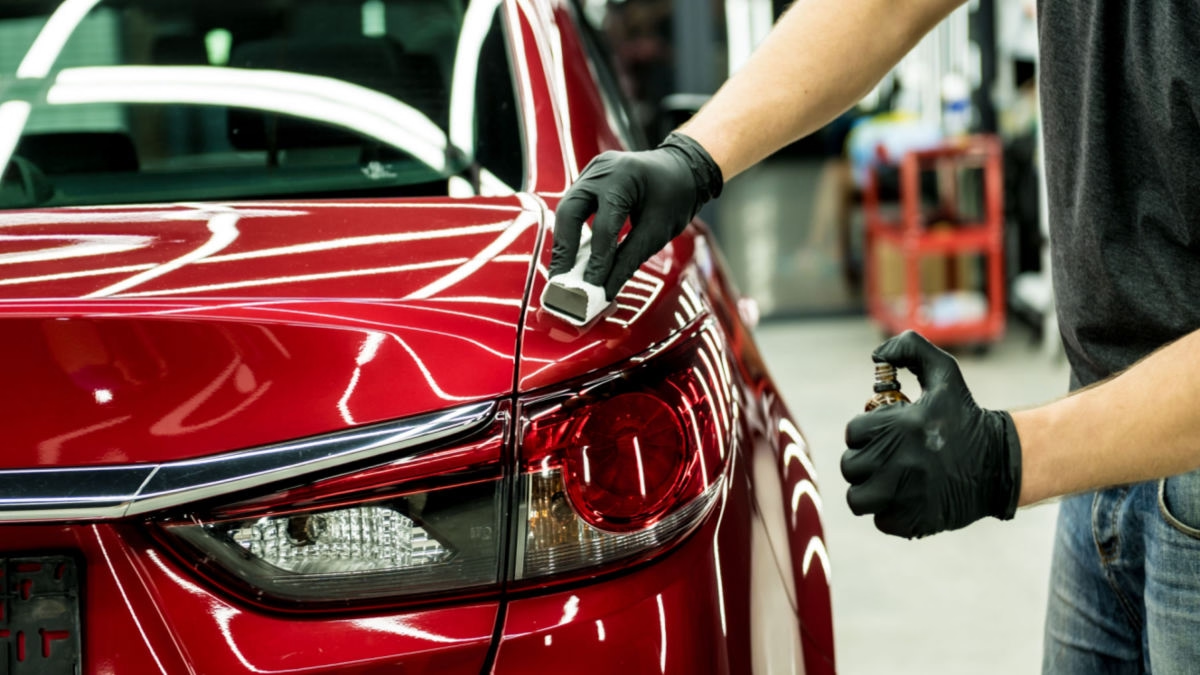
Professional ceramic coating runs $500 to $2,500, and most drivers pay $800 to $1,500. What sets the price, and how to read a quote that looks too cheap.


Professional ceramic coating costs between $500 and $2,500 for most vehicles, and the majority of drivers pay somewhere between $800 and $1,500. DIY kits run $50 to $150. Spray-on ceramic products sit around $20 to $40.
That is an enormous range, which is exactly why the question is so hard to answer. Two shops can look at the same car and quote $400 and $1,600 for something they both call a ceramic coating, and neither one is necessarily being dishonest. They are quoting different amounts of work.
This guide covers what you are actually paying for, why the spread is so wide, and how to tell a fair quote from one that will disappoint you in eight months.
One to two years of protection. Usually a single layer of consumer or prosumer grade coating applied over a wash and a light decontamination. Paint correction is minimal or skipped entirely, which means whatever swirl marks and light scratches are already in your paint get sealed underneath the coating instead of removed first.
On a brand new car with genuinely clean paint, this is a reasonable deal. On a three-year-old daily driver, you are paying to lock the existing damage in place for two years.
Three to five years of protection, and where most legitimate work lands. Expect full chemical decontamination, a clay treatment, at least single-stage paint correction to remove light defects, and one or more layers of professional-grade coating. This is the tier where you are paying for preparation as much as for product, which is the correct way round.
Five years to lifetime warranties, multi-stage paint correction, several coating layers, and often coverage extended to wheels, glass and trim as well as paint. Large vehicles, delicate or exotic paint finishes, and badly neglected paint all push into this range. Correction alone on a heavily swirled car can add $500 to $1,500 before a drop of coating goes on.
Genuine coating chemistry in a consumer-friendly form, and the products themselves are often good. The cost you are not seeing is the prep: to get a result worth having you need the same wash, decontamination, clay and correction a professional would do, plus a controlled environment and several hours. Skip that and you have sealed a dirty, swirled surface under a hard layer that will not come off easily.
Almost always, it is paint correction.
Ceramic coating is a clear, hard layer. It does not hide defects, it magnifies them. Gloss comes from a flat, uniform surface reflecting light evenly, so any swirl marks, etching or oxidation still present when the coating cures are locked in and made more visible, not less.
Correcting paint is skilled, slow, machine-polishing work. A single-stage correction on a sedan might take three to five hours. A multi-stage correction on badly weathered paint can take two full days. That labour, not the bottle, is where the money goes.
So when you compare a $450 quote with a $1,400 quote, the useful question is not "why is one more expensive" but "how many hours of correction is each one including". Ask both shops directly. A good installer will tell you plainly what condition your paint is in and what they plan to do about it.
A $300 to $400 "ceramic coating" is not automatically a scam, but it is almost always one of these:
The tell is the timeline. Proper preparation and coating on an average vehicle takes most of a day, and often longer. If a shop can take your car at nine and hand it back at noon, they have not corrected anything.
A $100 kit against a $1,000 installation looks like an easy decision until you price the rest of it. Doing the job properly at home means a dual-action polisher, pads, compound and polish, decontamination chemicals, quality microfibre, and good lighting. That is $300 to $500 of equipment before you start, plus a weekend and a learning curve on your own paint.
If you already detail your own car, enjoy the process and have somewhere clean and shaded to work, a DIY coating is genuinely worthwhile and the products are capable. If you are buying it because it looks cheaper, the maths is closer than it appears, and the failure mode is expensive: a badly applied coating has to be polished off before anything can be done properly.
The honest answer is that it depends on how long you are keeping the car.
A $1,000 coating rated for five years works out at roughly $200 a year. Waxing properly every three months, whether you pay for it or buy the product and spend the afternoon, lands in a similar place over the same period, and delivers nothing like the same chemical resistance or ease of washing. Over five years, the coating is the better value.
Over eighteen months, it is not. If you lease, or you tend to change cars every couple of years, a quality sealant every six months costs a fraction as much and covers the period you actually care about.
The strongest cases for coating are a car you intend to keep for years, a vehicle that lives outside rather than in a garage, a colour that shows swirls badly such as black or dark grey, and any car where you would like washing to stop being a chore. The hydrophobic effect is the benefit owners consistently rate highest, because dirt releases rather than clinging and a wash takes noticeably less time and effort.
Coatings are oversold often enough that the limitations are worth stating plainly.
Two to five years is the realistic range for professional applications, with entry products at the lower end and multi-layer premium work at the upper end. DIY kits typically deliver one to two years. Spray-on ceramic products last three to six months and are best understood as a maintenance topper rather than a coating.
Real-world durability depends heavily on how the car is washed. Automatic washes with spinning brushes will shorten the life of any coating significantly. Hand washing with a pH-neutral shampoo and a two-bucket method will extend it.
Our professional ceramic coating starts at $799 and carries three years of protection. That includes full paint decontamination and prep, single-stage paint correction, a multi-layer application, an aftercare kit and a maintenance guide. Final pricing depends on vehicle size and the condition of your paint, which is why we quote per car rather than publishing a flat rate.
If three years of coating is more than you need, we also offer a ceramic sealant upgrade at $100 that protects for around six months. It is the honest option for a leased car or a vehicle you plan to sell soon.
Coating is paint protection, not cleaning. If what you are pricing is a regular clean rather than long-term protection, see our car detailing cost guide instead.
We apply coatings at your home or office across Austin, Dallas and Houston. If you would like a quote, see our ceramic coating service or call us and we will give you a straight answer about what your paint actually needs.
Most drivers pay $800 to $1,500 for a professional coating. The full market range is roughly $500 to $2,500 depending on vehicle size, paint condition, coating grade and how much correction is included.
The cost is labour, not product. Preparing paint properly, including decontamination, clay treatment and machine correction, takes most of a day and requires skill and equipment. The coating itself is a small fraction of the price.
Yes, and consumer kits work. Budget $300 to $500 for polisher, pads and chemicals on top of the kit, plus a weekend. It suits people who already enjoy detailing; it is a poor shortcut for people who simply want it done.
Indirectly. It does not add a line item to a valuation, but paint kept free of oxidation, etching and swirl marks presents better and photographs better, which matters when selling privately.
Typically 25 to 50 percent more than a sedan, because there is more surface area to correct and coat. A full-size truck at the mid tier commonly lands between $1,200 and $1,800.